To the Frontier and Back Again

In September I gave a talk at [un]prompted.au in Sydney called To the Frontier and Back Again. The question behind it was simple. What does vulnerability research look like at the frontier right now, and how much of that can I bring back to models I can run myself?
The frontier half is two Windows system-service 0-days, found with Claude Code and Opus 4.8. The first confirmed root cause landed 1 hour, 16 minutes, and 5 seconds after my first request. The back-again half replays the same hunt on open-weight models: same target, same context, same tools.
Thanks to the [un]prompted.au organizers for a really well-run conference. A lot of the program circled the same thing I was there to talk about: agents, local models, and the feedback loops that make them useful.
![John McIntosh presenting To the Frontier and Back Again at [un]prompted.au in Sydney](/img/unprompted-2026-frontier-and-back.jpg)
Fast, Complex, and Not Autonomous
The two bugs are an arbitrary read and a write-what-where reached through a use-after-free. Neither is a bug you stumble into. One gets you past ASLR, the other is the kind of primitive that turns a crash into code execution.
I can't tell you what they are. Coordinated disclosure is still open on one, and naming the component points straight at the unfixed bug.
The setup was Claude Code and a Windows research environment. No custom harness, no MCP server. The speed is real, but it wasn't autonomous. The model needed direction, correction, and help with the tools, and that human work is part of the result. How the hunt actually ran, step by step, is the core of the talk.
Validation Is the New Work
If there's one idea I'd want you to take from the talk, it's this one:
AI finds the leads. We build the test that could prove it wrong. This is the new work.
Why is AI good at coding? The compiler tells it when it's wrong. Vulnerability research doesn't come with a compiler, so you have to build one: a rig that lets the agent test its claims against the real target and feeds the result back into the next pass. Leads got cheap. Knowing which ones are real is where the time goes now.
I contributed judgement, not knowledge. The model knew a lot. My job was noticing when the answer stopped matching the evidence.
![The audience and stage at [un]prompted.au during To the Frontier and Back Again](/img/unprompted-2026-conference.jpg)
And Back Again
Then I replayed the hunt on open-weight models: same binary, same files, same tools. Here's the first pass at rediscovering the read bug, unaided, one draw per model:
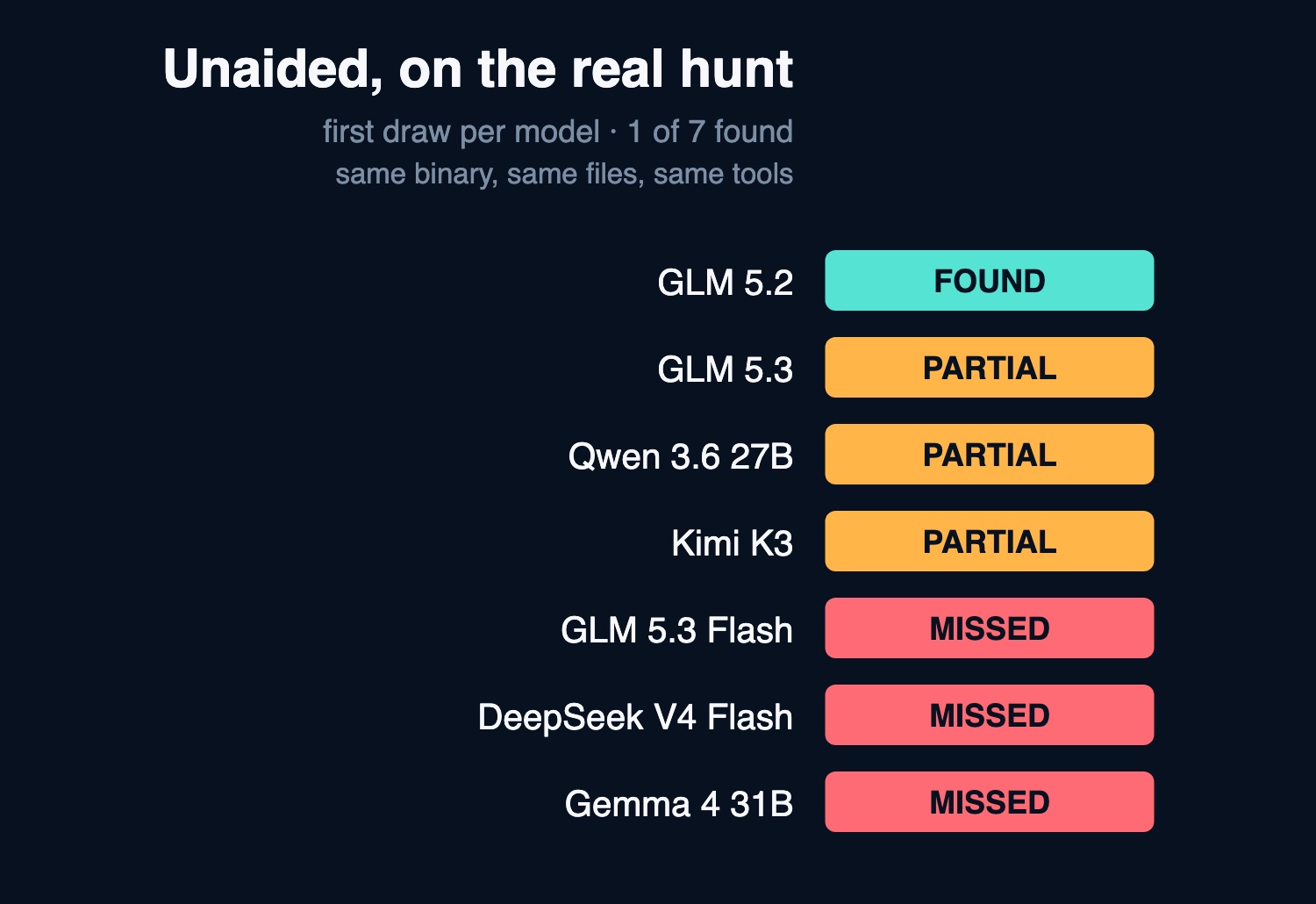
One of seven found it cold, and three more got partway. How the rest closed the gap, how much help they needed, and whether they could prove it on the rig is the other half of the talk.
If you missed it in Sydney, join the newsletter and we'll let you know where it turns up next.
You won't learn where these models are by watching from the sidelines. Pick a target, build the loop, and see what happens.
Learn the Loop From the Talk
The Agentic VR courses teach the methodology from this talk. Not a tour of my harness, but the approach behind the results: scoping a hunt with N-day patch diffs, building a rig that gives the agent real feedback, driving reconnaissance into leads, validating every claim against the disassembly, the debugger, and the live target, and taking a finding through to a report a vendor will accept. We do it with local models and compare against the frontier under the same standard of evidence.

Windows Agentic VR is the first of them. It runs as a CSL virtual course February 1–4, 2027 (live instruction 09:00–13:00 US Eastern, with the other half of each day for exercises), and as a two-day edition at Black Hat Asia on March 2–3. You'll work real Windows CVEs, build the loop that checks your work, and write a real MSRC report. Read the syllabus or register for the February cohort, where early registration savings run through December 15.
I'm also bringing this work into the closing section of Agentic RE, where the tools and models from earlier in the week come together into a research loop you can evaluate and improve. An Apple Agentic VR course is next on my list. More on that as it takes shape.
Want this for your team? Let's talk about private training.